
For years, Return on Ad Spend (ROAS) has been the preferred metric for digital advertisers aiming to evaluate their campaign success. ROAS provides a quick snapshot of how advertising investments translate into revenue. Yet, as advertising costs rise and competition intensifies, ROAS is proving to be a vanity metric that often obscures the true financial health of a business.
In today’s competitive landscape, where Google Ads Cost-Per-Click (CPC) can reach up to $2.69, eCommerce leaders are shifting their focus toward Profit on Ad Spend (POAS). This approach prioritizes actual profit generated over mere revenue volume, ensuring marketing budgets deliver genuine business value.
The ROAS Trap: Why Revenue Alone Isn’t Enough
ROAS measures total revenue generated per pound spent on advertising, calculated simply as:
- Revenue ÷ Ad Spend = ROAS
While straightforward, this formula treats every pound of revenue the same, regardless of the costs involved in producing or delivering the product. This mindset introduces several risks for eCommerce brands:
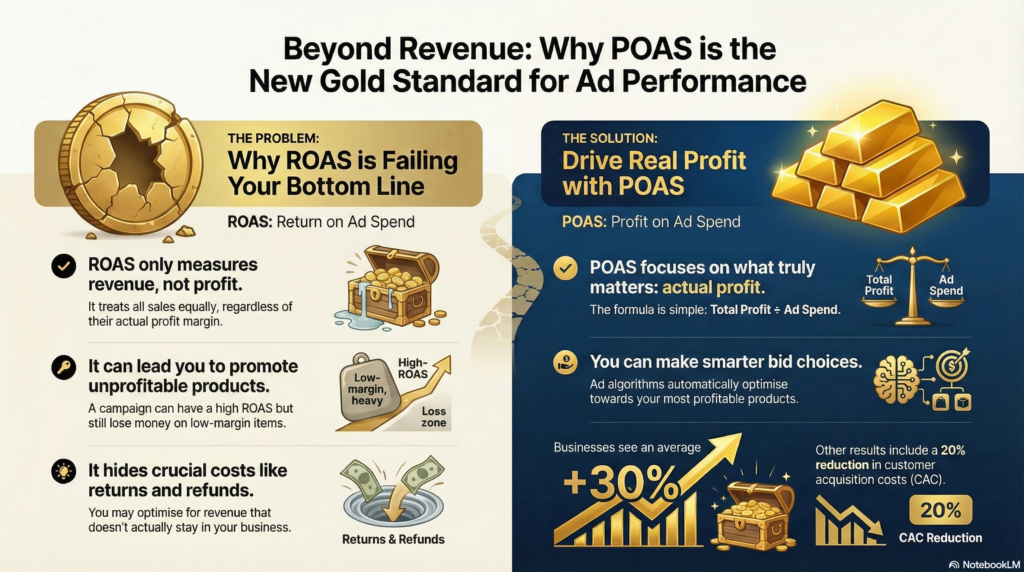
- Ignoring Margins: Platforms like Google and Meta prioritize high Average Order Values (AOV), often promoting deeply discounted orders that might generate revenue but cause net losses due to slim margins.
- Hidden Costs: ROAS overlooks crucial expenses such as product costs, shipping, transaction fees, and the impact of returns or refunds, thereby creating an inflated view of campaign success.
- Misallocated Spend: Algorithms optimizing purely for ROAS may over-invest in popular but low-margin products, while ignoring high-margin “hidden gems” that contribute more significantly to profitability.
Understanding POAS: A Profit-Centric Metric
Profit on Ad Spend (POAS) provides a more accurate picture by incorporating all variable costs into the calculation, using this formula:
- Gross Profit ÷ Ad Spend = POAS
Here, gross profit refers to revenue minus all relevant costs, including:
- Cost of Goods Sold (COGS)
- Shipping and handling
- Transaction fees (payment processing, marketplace commissions)
- Returns and refunds
By subtracting these expenses before dividing by ad spend, POAS reveals the actual profit earned per advertising pound invested. Unlike ROAS, which only tracks sales volume, POAS reflects business health and sustainable growth drivers.
The Key Difference: ROAS vs. POAS
Think of ROAS as a speedometer that tells you how fast you are moving—in other words, how much revenue you generate. POAS is like the fuel gauge that tells you how much profit you have left to keep going. High ROAS without profit can mean running out of fuel, while POAS ensures your business doesn’t break down mid-journey.
Transforming Advertising with POAS Bidding
The true power of POAS comes from integrating this metric into modern advertising platforms such as Google, Meta, and TikTok. These platforms now allow marketers to send refund-adjusted profit data directly as primary conversion events, enabling POAS Smart Bidding.
This integration empowers algorithms to:
- Optimize for genuine banked profit accounting for all product costs and refunds
- Bid aggressively on high-margin sales while reducing spend on unprofitable conversions
- Maintain visibility on profitable “loss leaders” when they strategically support customer acquisition or retention
Marketing teams adopting POAS bidding report significant benefits:
- A 30% increase in total profit by focusing on profit rather than just revenue
- A 20% reduction in Customer Acquisition Cost (CAC) through tracking new-customer profitability
- Greater ability to identify and scale truly profitable campaigns that ROAS alone would undervalue
Addressing the “Profit After Returns” Gap
Returns are a major blind spot for many marketers. Up to 20% of revenue may be refunded, yet standard ad metrics continue to credit these sales as conversions. POAS improves accuracy by using server-side tracking to automatically capture returns and refunds across channels.
This enables businesses to create custom “Profit After Returns” columns in their ad platforms, focusing optimization only on profit that remains post-refund—a critical step toward eliminating wasted spend.
How to Implement a POAS-Driven Strategy
Transitioning from revenue-focused to profit-first advertising requires deliberate steps:
- Identify true performance: Go beyond CTR and ROAS to evaluate which products truly move the profit needle.
- Calculate per-product profit: Deduct COGS, shipping, and transaction fees from revenue for each item to find net profit.
- Automate segmentation: Use tools to categorize products into groups like “Stars” (high profit and volume) and “Underperformers” (low profit but high spend), enabling real-time budget shifts.
This automation empowers campaigns to continuously adapt, concentrating spend on high-margin products while cutting losses on inefficient ones.
The Future of Advertising Metrics: Profit Over Revenue
POAS is more than a trend—it is a strategic imperative for sustainable eCommerce growth. As digital advertising costs climb and platforms leverage automation more heavily, success will depend on lighting up bidding algorithms with smart, profit-based data.
Marketers who refine their focus from raw revenue numbers to actual profitability will better allocate budgets, lower costs, and discover hidden profit drivers. This approach guarantees healthier growth in a fiercely competitive marketplace.
A Final Analogy
Using ROAS alone is like a fisherman trying to haul the heaviest net possible but catching a lot of seaweed and debris he can’t sell. POAS bidding, in contrast, is like casting a specialized net that filters out worthless material and retains only valuable fish, maximizing the true yield from every hour on the water.
Conclusion
While ROAS offers a useful snapshot of sales volume, it fails to reveal if those sales truly contribute to business profitability. POAS fills that gap by incorporating all variable costs and refunds, delivering a precise view of profit generated per advertising pound spent.
By adopting POAS metrics and bidding strategies, eCommerce brands can:
- Ensure marketing budgets drive real profit, not just inflated revenue
- Reduce wasted spend on unprofitable campaigns
- Leverage automation to optimize budgets toward high-margin products
- Adapt more effectively to rising ad costs and evolving market demands
Ultimately, POAS empowers brands to move beyond vanity metrics and build truly sustainable, profitable advertising engines in today’s competitive digital landscape.